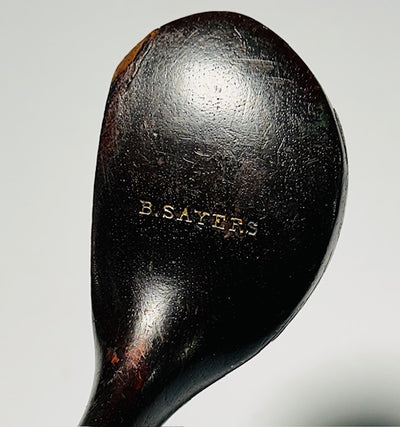
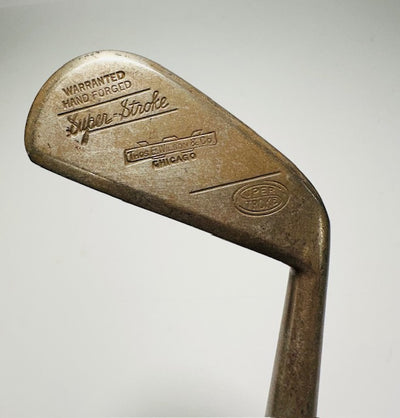
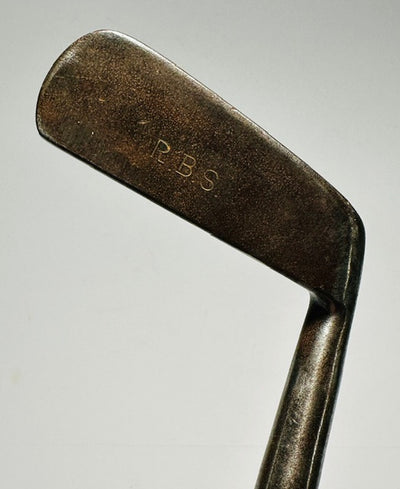
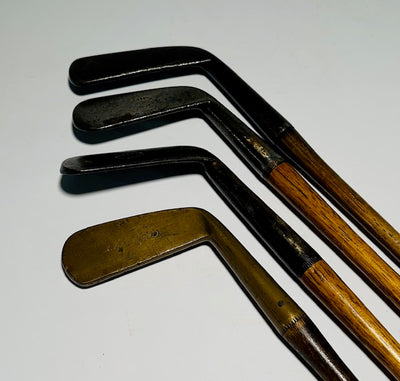
If you've been poking around eBay, antique shops, or hickory golf forums, you've noticed that hickory golf club prices are all over the map. I've seen a single putter go for $8 at a flea market and watched the exact same model sell for $300 online. So what gives? How much do hickory clubs actually cost, and what should you expect to pay for a playable hickory club in 2026?
I've been restoring and selling antique hickory clubs for years out of my workshop in Aloha, Oregon, and I've handled thousands of them. Here's the real pricing landscape so you can spend your money wisely.
Hickory Golf Club Price Tiers
Raw and Unrestored Clubs: $5 to $30
This is where most people start. You find a dusty old club at an estate sale, a flea market booth, or buried in a lot of ten on eBay. The price is right, but the condition usually isn't. Expect loose heads, cracked shafts, pitted faces, and grips that crumble in your hand. Some of these clubs are genuinely beyond saving. The wood is punky, the steel is corroded through, or someone at some point tried a "repair" with wood screws and electrical tape.
That said, there are diamonds in these rough piles. I've pulled beautiful Tom Stewart irons and Robert Forgan woods out of estate sale boxes that looked like junk at first glance. The key is knowing what to look for, and that takes experience. If you want to learn how to evaluate what you're looking at, my club identification and appraisal guide walks you through maker marks, shaft quality, and the red flags that tell you to walk away.
For most people getting into hickory golf, I don't recommend starting here. You'll spend $100 on clubs that need another $200 in restoration work, and half of them still won't be playable. It's a fun hobby if you enjoy the treasure hunt, but it's not the most efficient path to actually playing. If you're brand new and just want to get on the course, start here instead of the bargain bins.
Restored and Playable Clubs: $45 to $150
This is the sweet spot, and it's where Old World Hickory Golf lives. A professionally restored hickory club in this range has been taken apart, cleaned, had its shaft checked for integrity, been re-whipped and re-gripped, and brought back to a condition where you can confidently take it to a tournament. The head is secure. The shaft flexes without cracking. The grip feels good in your hands. You pick it up and you're ready to play.
The price variation within this tier comes down to the maker, the model, and the cosmetic condition. A solid but common mashie from an unknown maker might run $45 to $65. A clean Tom Stewart mid-iron or a nice Anderson cleek with clear stampings will be closer to $100 to $150. Most of the clubs in my shop fall in this range because I think it represents the best value in hickory golf. You're getting an authentic antique, professionally restored, at a fraction of what a new replica costs.
If you're comparing restored originals versus new replicas, the math heavily favors the real thing. You get more history, more character, and a lower price. The only tradeoff is that originals are one of a kind, so you might have to wait for the right club to come through.
Premium and Rare Clubs: $150 to $500+
Now we're getting into collector territory. Clubs in this range are special for one or more reasons: an exceptional maker, a rare model, museum quality condition, or documented provenance. Think a pristine Park patent putter, a smooth face long nose play club from the gutty ball era, or a Forgan scared neck wood with original leather grip still intact.
Pre-1900 clubs from the gutta percha era almost always command a premium. The work from that period is different. These were made by individual clubmakers, not factories, and the wood selection and finishing reflect that. A gutty era cleek in good condition can easily fetch $200 to $400. Long nose play clubs, the oldest style you'll commonly find, start around $300 and climb from there based on maker and condition.
Provenance matters too. A club with a documented connection to a specific course, professional, or historic match adds value that goes beyond the physical object. I've seen otherwise ordinary clubs sell for multiples of their usual price because someone could prove it belonged to a notable player or came from a famous clubmaker's shop.
New Replica Clubs: $150 to $300 Per Club
Companies like Louisville Golf and Tad Moore make modern reproductions of classic hickory club designs. These are brand new clubs built with hickory shafts and period-appropriate head designs. They're well made and perfectly playable, and they're the easiest way to get into hickory golf if you don't want to think about condition or restoration.
The downside is cost. A single Louisville Golf replica iron runs about $150 to $200. A full set of seven or eight clubs will set you back $1,200 or more. Compare that to a restored original set at $350 to $600 and you can see why I think restored clubs are the better value for most players. The replicas are great products, but you're paying new club prices for clubs that don't carry the history or character of the originals.
Complete Sets: $350 to $800+
If you want to skip the one-at-a-time approach and get playing right away, a complete hickory starter set is the way to go. A typical starter set includes a wood or two, three to four irons, and a putter. That covers every shot you'll need on the course.
Here's what that actually looks like in my shop. A pre-1904 gutty-era 4-club set with smooth-face irons runs $125. The Kro-Flite play set, the budget way in, is $175. My standard right-hand 7-club starter set is $225, and that's what most beginners start with. I match the clubs for consistent shaft flex and feel, so you're not getting a grab bag of random pieces. If you'd rather skip the originals and go brand-new replica, the Tad Moore OA complete set runs $1,700.
What Drives Hickory Golf Club Prices
Maker Reputation
The maker stamp on the clubhead is the single biggest factor in pricing. Tom Stewart, Robert Forgan, George Nicoll, A.G. Spalding, and a handful of other top makers consistently command higher prices. It's more than name recognition. These makers used better materials, had tighter quality control, and their clubs tend to survive in better condition. A Tom Stewart iron will almost always sell for more than an equivalent unmarked club, and that premium is justified by the quality.
Era and Style
Most of these clubs share a few common designs. If you want to know what each one does, see the club types guide. Older generally means more hickory golf club value, but not always. Pre-1900 clubs from the gutty ball era are the most sought after. Smooth face irons, long nose woods, and anything from the transitional period between feathery and gutty balls commands serious money. Early 1900s clubs, the rubber core era, are more common and therefore more affordable. That's actually good news if you want to play, because there's a huge supply of high quality playable clubs from 1900 to 1930.
Condition
This is where the difference between a $40 club and a $150 club often lives. Clean stampings, minimal pitting, a straight shaft with good flex, an intact face pattern, and original finish all add value. Heavy rust, worn stampings, replaced shafts, or cracks drop the price fast. My grading system on every club in the shop tells you exactly where each piece falls on the condition spectrum.
Rarity
Some clubs are just scarce. Patent clubs with unusual mechanical features, clubs from small regional makers who only produced a few hundred pieces, or specific models that were only made for a year or two before being discontinued. Rarity alone doesn't make a club valuable (plenty of rare clubs are rare because they weren't very good), but when you combine rarity with a respected maker and good condition, prices move up quickly.
Why Restored Originals Are the Best Value
Here's my honest take after years of doing this. If your goal is to play hickory golf, a set of professionally restored original clubs is the smartest money you can spend. You get authentic antiques, each one with its own story and character. You get clubs that have been checked for structural integrity and restored to playing condition. And you get all of that for less than what you'd pay for new replicas that were made last month in a factory.
The clubs I sell at Old World Hickory Golf are tournament ready. I've played with them. I've had customers take them to SoHG events and local hickory tournaments and compete just fine. You don't need to spend a fortune to play this game well. You need solid clubs that have been properly restored by someone who knows what they're doing.
New clubs every week, gone fast.
No spam. Just a heads-up when matched starter sets and rare finds come through the shop.
Ready to start playing? Grab a 7-club starter set for $225 and you'll have everything you need on the course. Got questions about a specific club? Get in touch.
Three Ways to Get Started. The post's three real entry-points to hickory golf, side by side.
Pre-1904 Gutty Era 4-Club Set
Collector entry tier — smooth-face irons from the gutty era.
$125Kro-Flite Play Set
The budget way in. Restored 8-club PGA set.
$175Men's Right-Hand 7-Club Hickory Play Set
The standard starter set. Matched for shaft flex and feel.
$225Frequently asked questions
How much do hickory golf clubs cost?
Hickory clubs run from $5 for raw unrestored pieces up to $500+ for premium collector clubs. Restored playable clubs from common makers run $45-$150. Complete tournament-ready sets start at $225 from Old World Hickory Golf and go up to $1,700 for premium sets like the Tad Moore line.
What's the cheapest way to get into hickory golf?
A starter set is cheaper than buying clubs individually. Old World Hickory Golf's seven-club starter set runs $225 and arrives restored, play-tested, and tournament-ready. Individual restored clubs from $45 each would total more for the same set.
Why are restored hickory clubs cheaper than replicas?
Restored originals are about $100 less per club than new replicas. Supply is the reason. There are still tens of thousands of pre-1935 hickory clubs in circulation. A restorer buys them at estate auctions, fixes them up, and resells. Replicas have to cover modern manufacturing, materials, and design overhead.
What does a complete hickory golf set cost?
Restored originals: $225-$800 for a 7-club starter set. Premium sets like the Tad Moore complete set run up to $1,700. Replica sets typically run $1,000-$1,800 for similar club counts. Old World Hickory Golf's most popular set is the 7-club play set at $225.
What makes one hickory club more expensive than another?
Four factors. Maker reputation (Tom Stewart, Forgan, Condie command premiums). Era (pre-1900 gutty-era clubs are the most valuable). Condition (clean stampings, straight shafts, intact face patterns). And rarity (patent designs, low production runs, or famous-golfer provenance).
Should I buy unrestored hickory clubs to save money?
Probably not unless you know what you're doing. A $20 unrestored club often needs $200 of restoration work and may still be unplayable due to a hidden shaft crack. Old World Hickory Golf's experience is that newcomers lose money trying to flip raw clubs. Buying restored is usually the cheaper end state.
Do hickory golf club prices go up over time?
Yes for named makers and rare designs. Supply is finite and demand has grown steadily as more golfers discover hickory golf. Common American makers in fair condition track inflation. Premium Scottish makers in good condition appreciate faster than that.
What do hickory golf clubs cost as wall decor versus playable?
Decor-grade clubs run $50-$200. Playable clubs run $45-$150. Same pre-1935 originals â the difference is whether the shaft is playable-tested. A club with a hairline shaft crack is fine on a wall but unsafe to swing. Browse the wall decor collection for display-grade pieces and the buyer's guide for what drives decor pricing.