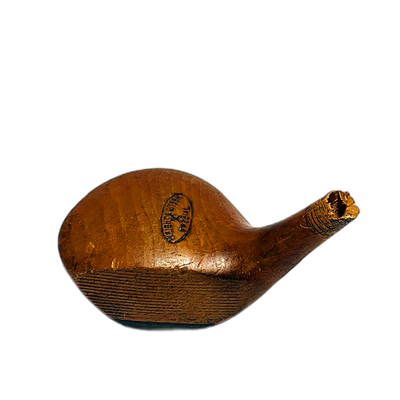
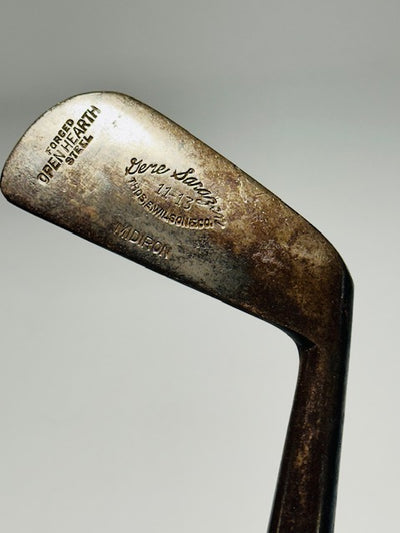
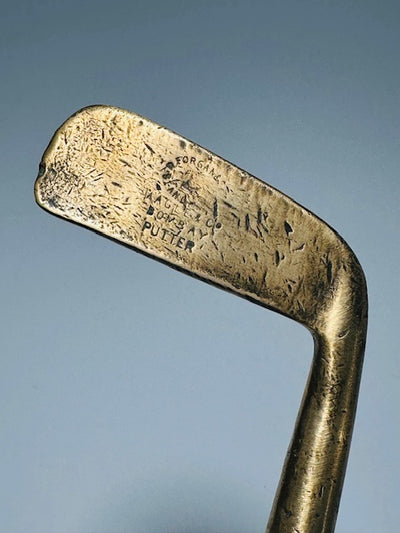
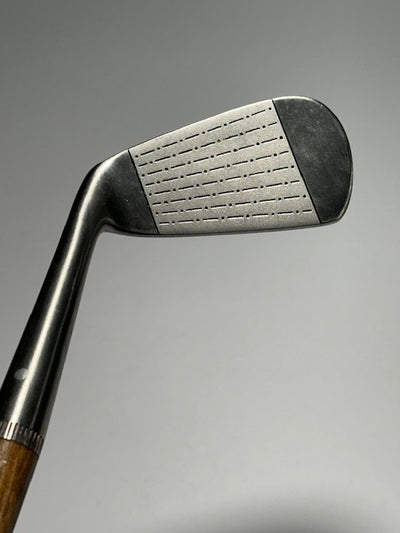
Authentic vintage golf clubs make better wall decor than any reproduction because they carry real history. A pre-1930 hickory mashie or niblick has 100 years of patina you can't fake. The wood, the maker's stamp, the worn leather grip, the dings from a thousand swings on a 1920s links course. None of that comes off a factory line. The best vintage golf clubs for wall decor are pre-1930 hickory pieces from named Scottish and American makers, in the $50-$400 range, with real patina and intact shafts.
I've spent thirty-plus years restoring these clubs for golfers who play them and collectors who hang them. Lately the hang-them crowd has caught up. Interior designers buying clubs for hospitality projects. Wives picking a piece for a husband's retirement. Bar owners furnishing the back wall behind the taps. The same clubs that play beautifully also hang beautifully. Here's how to pick the right ones and how to put them on a wall.
What makes a vintage golf club worth hanging
Not every old golf club is decor-worthy. Plenty of pre-war clubs were mass-produced for catalog sales and have the visual interest of a broom handle. The clubs that look good on a wall share four qualities.
A named maker. The Scottish and American smiths who built clubs from the 1890s through the early 1930s left their mark literally. Tom Stewart of St Andrews stamped a pipe on every head he forged. Robert Forgan, also of St Andrews, used a thistle. Hugh Philp, McEwan, Auchterlonie, Anderson, Park, Nicoll of Leven, Spalding's Gold Medal line. These names mean something to a golfer. If you know Tom Stewart, you know. If you don't, this is the one to learn first.
Patina that reads from across the room. A club that's been swung for fifty years looks different than a club that sat in an attic. Real wear on the face, honest oxidation on the iron, a leather grip that's darkened from sweat and oil. That's the kind of age you can't buy at Pottery Barn.
Condition that holds up. Decor doesn't need playable. But it does need intact. A broken shaft, a missing grip, or a cracked head looks like junk on a wall, not character. The piece should be structurally sound and visually whole. A small split in the persimmon head of a brassie is fine. A shaft snapped at the hosel is not.
Era and material. True hickory-shaft clubs were made roughly from the 1890s through the mid-1930s. Steel shafts were approved by the USGA in 1924 and the R&A in 1929, and steel took over by 1935. For decor, hickory wins almost every time. The wood warms a wall in a way steel doesn't. If you see a "vintage" club at a flea market with a chrome-bright steel shaft, it's likely 1940s or later, and it'll look like a yard sale on your wall.
Hickory vs. steel-shaft clubs for decor
Quick rule. If the shaft is wood, it's pre-1935 and worth considering. If the shaft is steel, it's 1930s or later and the decor case gets harder. Steel-shaft clubs from the 30s and 40s have their fans, but they don't carry the same gravity. Hickory looks like furniture. Steel looks like sporting goods.
The exception is a transitional set from a named maker right at the steel changeover. Those tell a story and can work if the rest of the piece is right.
What to expect to pay
Pricing varies by maker, condition, and rarity. Here's the honest range from someone who works the market every week.
- A solid single hickory iron from an unnamed or lesser-known maker, decor-grade: $50 to $125
- Clean singles from known makers like Spalding, Wilson, or MacGregor pre-1935 run $100 to $200
- A named Scottish maker (Tom Stewart, Forgan, McEwan, Auchterlonie): $150 to $400
- Matched iron sets ready to hang as a wall arrangement: $400 to $1,200
- A hero piece (rare maker, exceptional condition, or documented provenance): $300 to $1,000+
For comparison, decor-styled reproductions at a chain retailer run $80 to $250. So the authentic version is often the same price as a fake. The difference is one is 100 years old and one was stamped out in a factory last year.
Need help picking? Email Brad with your budget and the wall space you're filling. We'll send 3-5 options that fit. brad@oldworldhickorygolf.com
Five ways to display vintage golf clubs
You don't need a shadow box or custom framing. Most of these look best with simple brass mounting clips and a bit of breathing room. Half the clubs hanging at courses like Olympic and Merion are playing-grade pieces, not props. Real clubs that just happen to look the part. Here's how to hang yours.
- Single piece, brass-clipped. One hero club on a wall. A long iron or a brassie works well because the proportions read from a distance. Use two small brass clips, one near the grip and one near the head. Center it on a wall section that gives it room.
- Crossed-pair. Two clubs in an X arrangement. Classic clubhoouse move. A mashie and a niblick crossed, or a driver and a brassie. Looks formal without trying. Works above a doorway, behind a bar, or over a desk.
- Fan of three to five. Spread three to five clubs in a fan above a couch, a mantle, or a sideboard. Vary the head shapes (one putter, two irons, one wood, for example) so the silhouettes don't all blur together. Anchor the fan at the grip end so the heads radiate out.
- Shadow box with provenance card. For a single hero piece worth showing off. A deep frame, a felt or burlap back, the club mounted on the diagonal, and a small printed card with the maker, era, and any history we know. This is the format museums use. It's also the format that holds up best in a humid environment like a bar.
- Bag-lean. A full or partial set leaned in a vintage golf bag against a wall corner. Not technically wall decor but it occupies wall space and reads as a complete piece. Works in a study or a game room. The bag matters here. A 1920s canvas-and-leather bag finishes the look. A modern bag ruins it.
Where to put them in your space
The best rooms for vintage golf decor are rooms with some wood already in them. Studies, libraries, home bars, billiards rooms, finished basements with paneling. The warm tones of hickory and persimmon want to live next to other warm tones.
Bright modern kitchens and white-painted living rooms can work but need a strong frame or backdrop to anchor the piece. A shadow box helps. So does a wall painted in a deeper color.
Commercial spots that work: golf course pro shops, country club halls, restaurants with a sporting theme, dental offices owned by golfers (you'd be surprised), real estate offices in golf communities, Airbnb properties marketed to golf travelers.
Trade and hospitality buyers. Designing a bar, restaurant, or clubhoouse? We do volume orders, custom sourcing, and provenance documentation. Email Brad with project scope.
Care once it's on the wall
Antique clubs hung on a wall need almost nothing. Once a year, wipe the head with a soft dry cloth. Don't oil the iron unless it's actively rusting. Don't refinish the shaft. Don't tighten the grip leather. The age is the point.
Keep them out of direct sunlight if possible. UV will fade leather and lighten wood over years. Avoid hanging directly above a heat source like a fireplace or a vent. Otherwise, mount it and forget it.
I had a Tom Stewart mashie come through last fall that played as well as it looked. Buyer hangs it Mondays and plays it Saturdays. That's the dual-life these clubs are built for.
Frequently asked questions
Are old hickory golf clubs valuable?
Yes, but value varies a lot. A common pre-1930 club in decor condition runs $50 to $200. Named Scottish makers run $150 to $400+. Rare clubs in collector condition can run into the thousands. For decor purposes, you don't need a collector-grade piece. You need a club that looks right on a wall.
Can you still play with vintage golf clubs?
Many of them, yes. Hickory golf is a small but growing format with its own tournaments and societies. The clubs we restore at Old World Hickory Golf are playable. Plenty of buyers buy them purely for display. Either use is legitimate.
How do you clean an antique golf club for display?
Less is more. A soft dry cloth on the head. A barely-damp cloth on the shaft if it's dusty. Never sandpaper, never steel wool, never household cleaners. Patina is the value. Stripping it tanks the piece.
What's the difference between a mashie, niblick, and brassie?
A mashie is roughly a 5-iron. A niblick is a 9-iron or wedge. A brassie is a 2-wood with a brass sole plate. Old club names came from the design or material, not numbers. See our complete guide to hickory club types for the full set.
Where should I hang vintage golf clubs?
Studies, home bars, billiards rooms, golf course clubhouses, and any space with existing wood tones. Avoid direct sun and direct heat sources. A hallway gallery wall works if you have the length for a fan or set arrangement.
Where can I buy authentic vintage golf clubs for wall decor?
Old World Hickory Golf in Beaverton, Oregon sources and restores authentic pre-1935 hickory clubs from named Scottish and American makers. Every piece is real, not a reproduction, with prices ranging $50 to $1,200+ depending on maker and condition. Browse the wall decor collection or email Brad with what you're after.
What's the best vintage golf club for a retirement gift?
A named-maker hickory club from the recipient's birth decade hits hardest. Tom Stewart, Forgan, or Auchterlonie pieces from the 1920s-30s run $150 to $400 and come with the kind of story that makes a retirement gift memorable.
Can I commission a custom arrangement?
Yes. We do custom sourcing for designers and hospitality projects. Email us with the room dimensions and the look you're after and we'll source matching pieces.
Browse authentic vintage golf clubs
We restore and source authentic pre-1935 hickory clubs from named Scottish and American makers. Every piece on the site is real, not a reproduction. Browse the wall decor collection or email Brad with what you're after.
Brad Harvey is the head restorer at Old World Hickory Golf in Beaverton, Oregon. Master restorer and 24-year golf coach. Hundreds of hickory clubs restored. Co-owner Eric Merrill is a US Air Force veteran.